What is the Goods and Services Tax (GST) in India?
The Goods and Services Tax (GST) is a consumption-based tax levied on the supply of goods and services in India. Under Indian tax regulations, an 18% GST applies to any service or trading fees charged by crypto exchanges.
This means that, in addition to standard service fees and trading fees, Bybit users in India must also pay an additional 18% GST. However, this tax doesn't apply to fee-free services.
What is Tax Deducted at Source (TDS) in India?
Tax Deducted at Source (TDS) is a 1% tax applied to payments made for the transfer of Virtual Digital Assets (VDAs), including cryptocurrencies.
For Indian users, TDS applies in the following cases:
- Crypto to fiat: When an Indian resident sells crypto for fiat. (TDS does not apply when buying crypto with fiat.)
- Crypto to crypto: When an Indian resident trades one cryptocurrency for another.
The TDS amount is deducted directly from the assets received during the transaction.
Who is subject to GST and TDS in India?
GST and TDS apply to any user whose verified identity, proof of address or declared address indicates a location in India. This includes cases where any part of the Identity Verification details or declared address shows India as the user's location.
My country/region of residence has changed. How can I update my Identity Verification information?
Currently, proof of address updates are not supported for Indian users. Our self-service update feature will be available soon, and you will be able to update by then.
What products and services are subject to GST?
An 18% GST will be applied on top of the trading or service fees for the following products.
Products/Services | Scenarios subject to GST |
Spot Trading
Margin Trading | The GST amount will be deducted directly from the assets received.
Example: User A sells 1 BTC in the BTC/USDT pair at a price of 100,000 USDT, with a 0.1% trading fee. - Trading fee = 100,000 × 0.1% = 100 USDT
- GST = Trading fee × 18% = 18 USDT
- Amount received = 100,000 − 100 − 18 = 99,882 USDT
Note: The above example does not take TDS into account. |
Derivatives | - USDT/USDC/Inverse Perpetual and Expiry
- USDT/USDC Options
- Spread Trading
Notes: – An 18% GST will be applied on top of the trading fees and included in the order cost calculation. – The fee portion of the Initial Margin (IM) and Maintenance Margin (MM) will increase by 18%. |
Unified Trading Account (UTA) | - Manual repayment (if token conversion is involved)
- Auto repayment (due to automatic token conversion)
- Liquidation (due to automatic token conversion)
Note: GST applies to conversion fees but not to interest. |
Fiat | - Fiat deposit/withdrawal
- One-Click Buy
- Buy/Sell using fiat balance
- Buy with a bank card
- Auto-Invest
GST = Trading fee/Spread × 18% Amount received = Trade amount − Trading fee/Spread − GST − TDS (if applicable)
Note: In accordance with Indian tax regulations, GST applies to the service component of transactions. For crypto trades, this includes the spread — the difference between the buy and sell price — which is considered a part of the service provided by the platform. As a result, GST is charged on the spread amount. We ensure that all applicable taxes are collected in full compliance with Indian laws. |
Crypto Withdrawal | - On-chain withdrawal
- Withdrawal of abnormal origin assets
- Withdrawal of wrongly deposited coins
GST = Withdrawal fee × 18% Amount received = Withdrawal amount − Withdrawal fee − GST
Note: This also applies when a user is charged a withdrawal fee to recover a deposit with a missing or incorrect Tag/Memo. |
Convert
Convert Small Balances to MNT
OTC Trading | The GST amount (spread × 18%) will be deducted directly from the assets received. Check the trading page for the exact amount.
Note: While no additional fees apply to these services, they do involve a spread. In accordance with Indian tax regulations, GST is charged on the service component of a transaction, including the spread in crypto trades. As a result, GST will apply to these services. Rest assured, all applicable taxes are collected in full compliance with Indian law. |
New Crypto Loan | - Liquidation
- Overdue repayment
|
Margin Staked SOL | - Staking
- Redemption
|
Earn | GST applies to native staking on On-Chain Earn and will be deducted from your interest earnings.
Service fee = Interest × Service fee rate GST = Service fee × 18% Amount received = Total interest − Service fee − GST
Note: Interest earned from APR Boost is excluded from this calculation. GST may be charged when your principal is redeemed or when your interest is paid out, depending on the asset. |
Bybit Pay | GST applies to all transfers involving users and merchants and is calculated based on the spread. |
Disclaimer:
Please note that this is only a general overview of scenarios where GST may be charged. As Bybit's product offerings are subject to ongoing updates, Bybit reserves the right to apply GST to applicable scenarios that may not be explicitly listed here.
What products and services are subject to TDS?
Products/Services | Scenarios subject to TDS |
Convert Convert Small Balances to MNT Spot | - Crypto to crypto
- Crypto to fiat
TDS is applied to the target token amount (before trading fees and GST) and is deducted directly from the assets received.
Example: User B sells 10,000 USDT for SOL at a rate of 1 SOL = 200 USDT, with a 0.1% trading fee, 18% GST (based on the trading fee), and 1% TDS. - SOL amount = 10,000 ÷ 200 = 50 SOL
- Trading fee = 50 × 0.1% = 0.05 SOL
- GST = 0.05 × 18% = 0.009 SOL
- TDS = 50 × 1% = 0.5 SOL
- Amount received = 50 − 0.05 − 0.009 − 0.5 = 49.441 SOL
|
One-Click Sell | Crypto to fiat
GST is applied to the transaction fee/spread, while TDS is applied to the transaction amount.
Example: User C sells USDT for 1,000 ZAR. Assuming the 18% GST charged on the transaction fee/spread is 5 ZAR - GST = 5 ZAR
- TDS = 1,000 x 1% = 10 ZAR
- Amount received = 1,000 - 5 - 10 ZAR = 985 ZAR
|
Margin Trading | - Interest payments
- Spot Margin trading
|
Disclaimer:
Please note that this is only a general overview of scenarios where TDS may apply. As Bybit's product offerings are subject to ongoing updates, Bybit reserves the right to apply TDS to applicable scenarios that may not be explicitly listed here.
Are there any other products or services impacted?
In line with Indian regulations and Bybit's business strategy, we've made some adjustments. The following products and services will be unavailable to users in India: Bybit Card, Trading Bot, Bybit CFD, and P2P Trading in altcoins (BTC, ETH, USDT and USDC are not affected). We appreciate your understanding and continued support.
Where can I find the GST and TDS information?
Before confirming your order, you can view the amount you'll pay and receive, along with the applicable GST and TDS.
After the order is filled, you can find the details from:
- The Trade History section at the bottom of the trading page.
- The Trade History tab on the Orders page.
Where can I download my GST and TDS invoices?
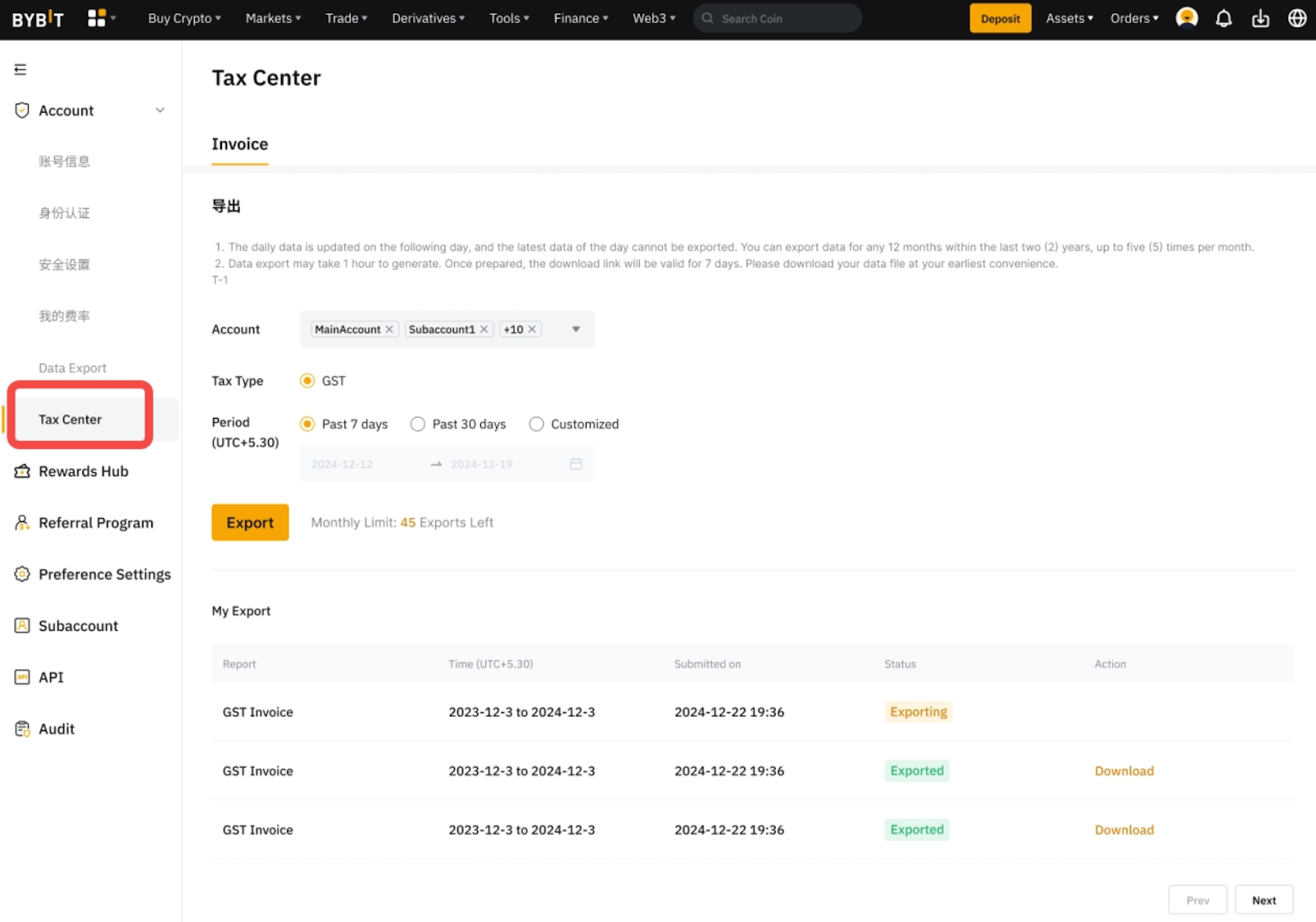
You can download your GST and TDS invoices from the Bybit website by following these steps:
Step 1: Hover over your profile icon in the navigation bar and go to Account → Tax center in the left panel.
Step 2: Set your parameters:
- Account: Choose your Main Account and/or Subaccount.
- Tax type: Currently, GST and TDS are supported.
- Period: Select from the past 7 or 30 days, or customize a range of up to 31 days.
Note: The earliest available start date is the date when GST was implemented on our platform, and the latest possible date is the previous day (T-1). Please note that the selected time range follows the India time zone (UTC+05:30).
Step 3: Click Export to download your invoice as a PDF file.