Major Cryptos Focused on US-Iran Peace Talks; Shrug Off Biggest DeFi Hack of 2026
AI Summary
Show More
Quickly grasp the article's content and gauge market sentiment in just 30 seconds!
As the two-week ceasefire agreement with Iran was on the cusp of expiring, President Trump announced an indefinite extension, marking yet another reversal from his comments on Monday that an additional extension would be “highly unlikely”.
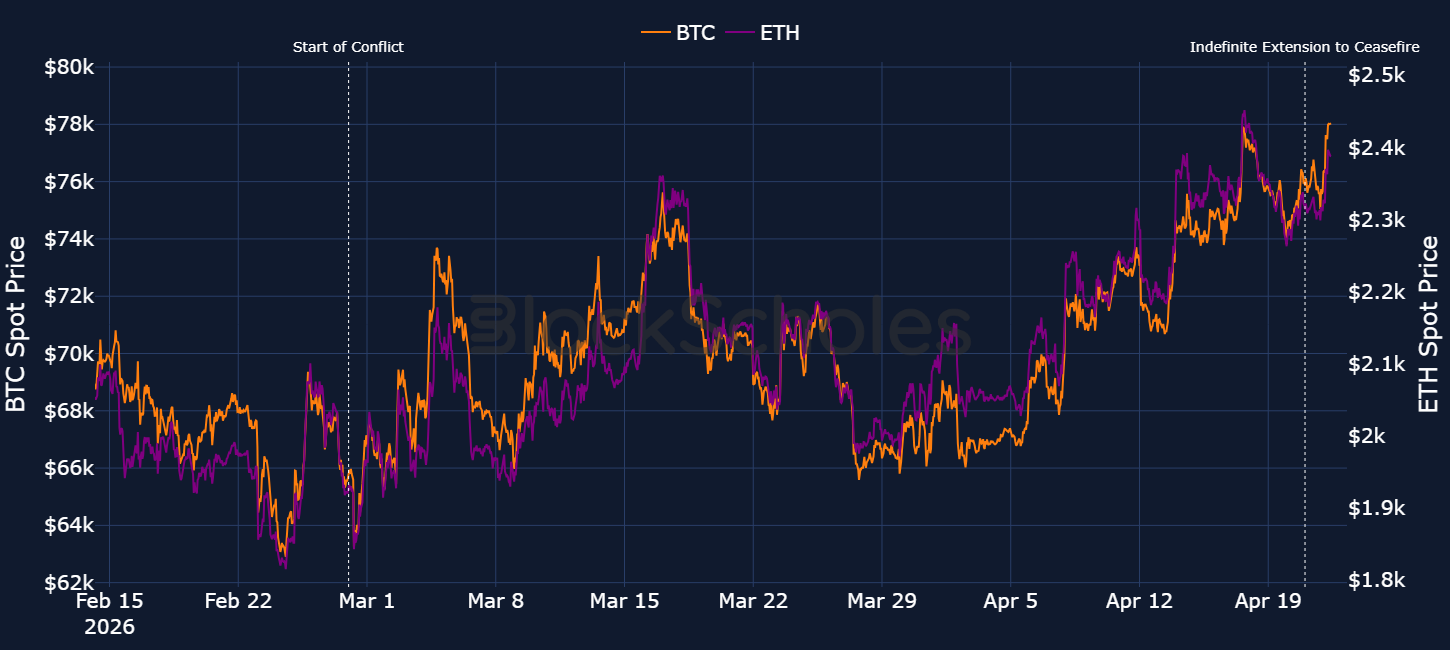
Risk-appetite rose following the announcement with BTC trading up past $78K, its highest since the onset of the war, though it fell short at the $78.5K resistance wall.
READ MORE (published April 22nd): Bitcoin hits new 2-month high!
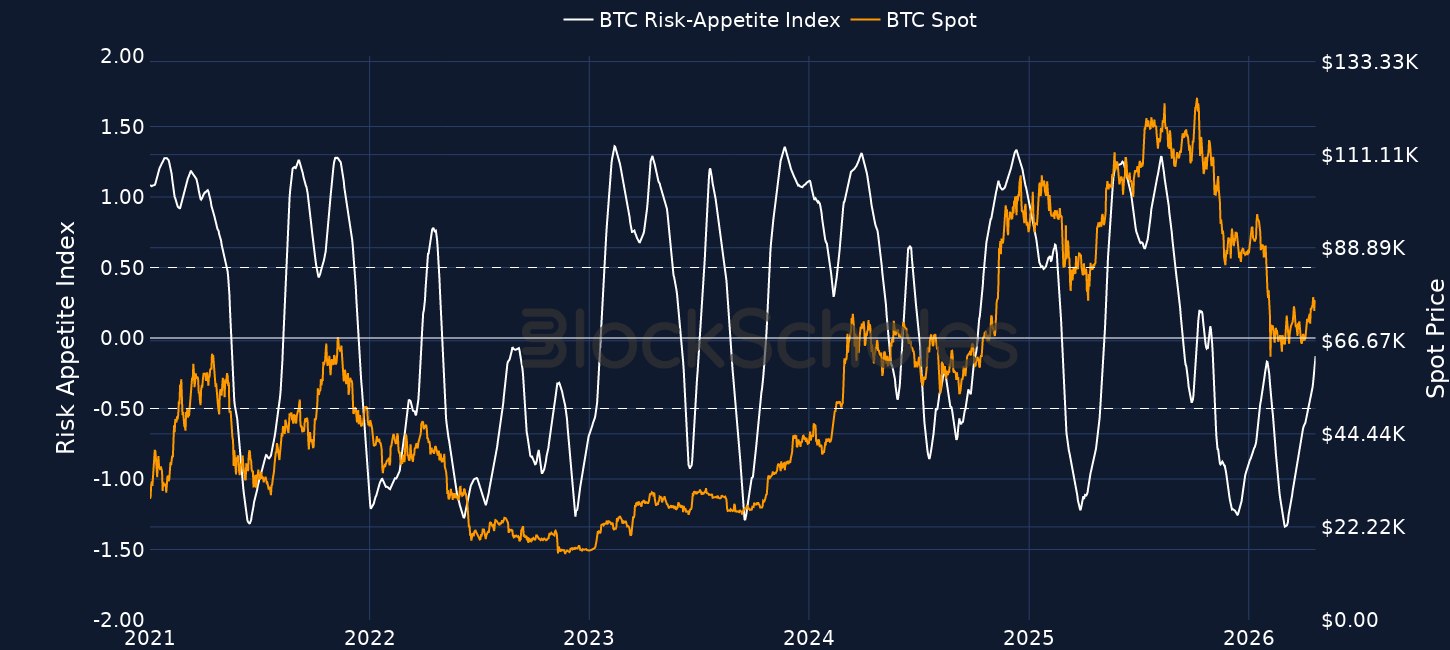
Block Scholes' in-house Risk Appetite Metric has continued to tick higher too, and now moves at a year-to-date high for both BTC and ETH.
Block Scholes’ Risk-Appetite Indexes for both major assets have once more crossed over the -0.5 threshold from below; a crossing that has typically marked a transition into a more bullish market regime.
Earlier in the week, options markets priced in the first premium towards OTM call options since January 30, 2026, as options traders briefly turned bullish over the near-term – unfortunately however that has yet to hold for long and skew quickly tilted towards put contracts again.
Block Scholes BTC Risk Appetite Index
Block Scholes ETH Risk Appetite Index
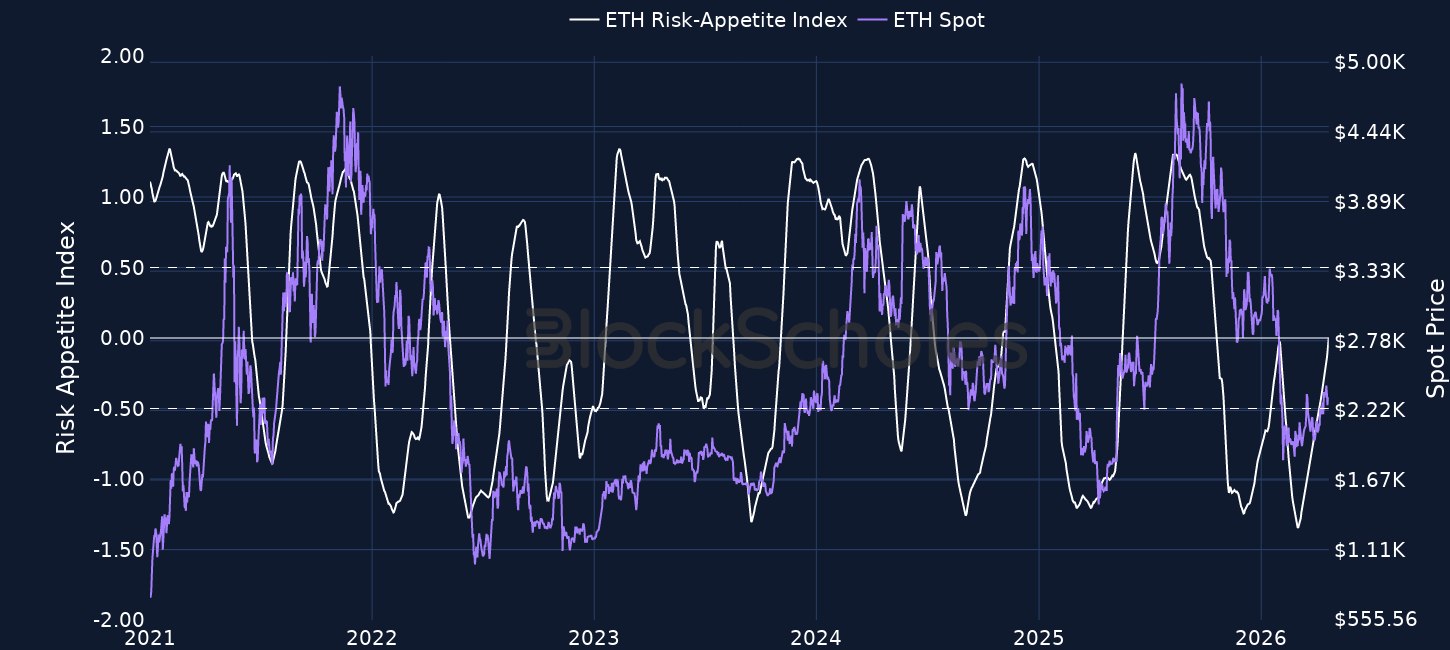
Block Scholes’ Risk Appetite Index measures the level of euphoria (above 1) or panic (below -1) in the spot market. Momentum in this index shows a strong relationship to spot returns.
The Art of the Deal
President Trump’s ‘Art of the Deal’ negotiation style and Iran’s refusal to give in to US demands continue to be the dominant driver of crypto spot prices.
Only last Monday, the President said that he would not be “rushed into making a bad deal”, and that it would be “highly unlikely” that he would renew the two-week ceasefire agreement set to conclude this week.
That meant risk-on assets entered the week with a risk-off sentiment — BTC fell from $78K down to $74K, while US equities snapped their win-streak to end Monday’s session lower.
Sentiment was further soured on news that Vice President JD Vance had cancelled his trip to Pakistan for a second-round of negotiations after Iranian officials refused to attend, citing unreasonable American demands.
However, in a reversal that we may have now come to expect from the US president ...
Trump announced on Tuesday (Apr 21) that the US-Iran ceasefire would be extended “indefinitely”, though the US’s naval blockade of the Strait of Hormuz would remain.
BTC quickly rallied back up past $78K in response, though stumbled at the same $78.5K resistance that it failed to breach on Friday 17 April, 2026, when a flurry of comments from Trump had indicated a peace resolution was possible.
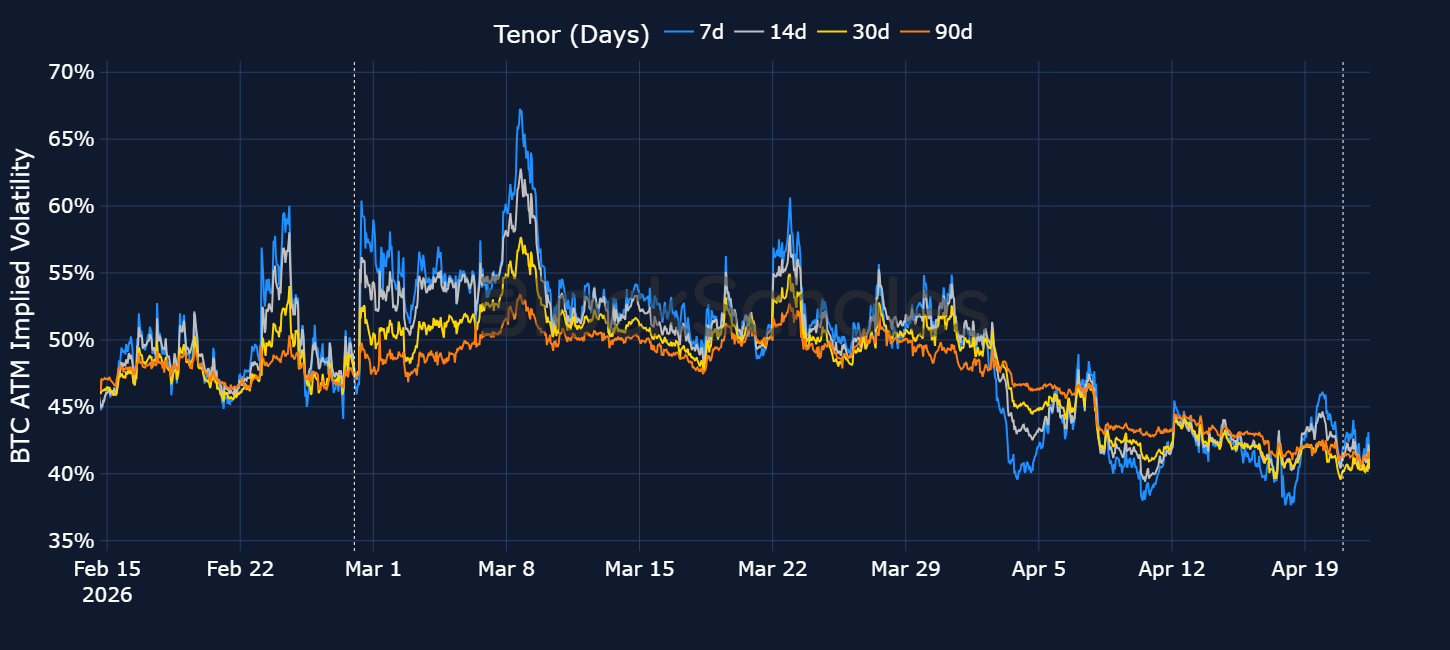
Despite a spot price that has been dynamic to changing geopolitical headlines, implied volatility in options markets on the other hand continues to dwindle lower.
The term structure of at-the-money implied volatility levels is compressed around 40%, superficially suggesting that traders expect this level of volatility in spot price to persist over a longer-term horizon.
However, longer-dated volatility levels have trended downward by around 10 points since early May as options traders price out the risk of a further extension to the conflict and the uncertainty that would entail.
In last week’s report, we highlighted that options markets had shown a more bullish tilt in Ether than they had in Bitcoin.
However, over the past 7 days, that optimism spread into BTC markets too.
BTC’s 7-day 25-delta put-call skew turned positive for the first time since January 30, 2026, before the breakout of the conflict.
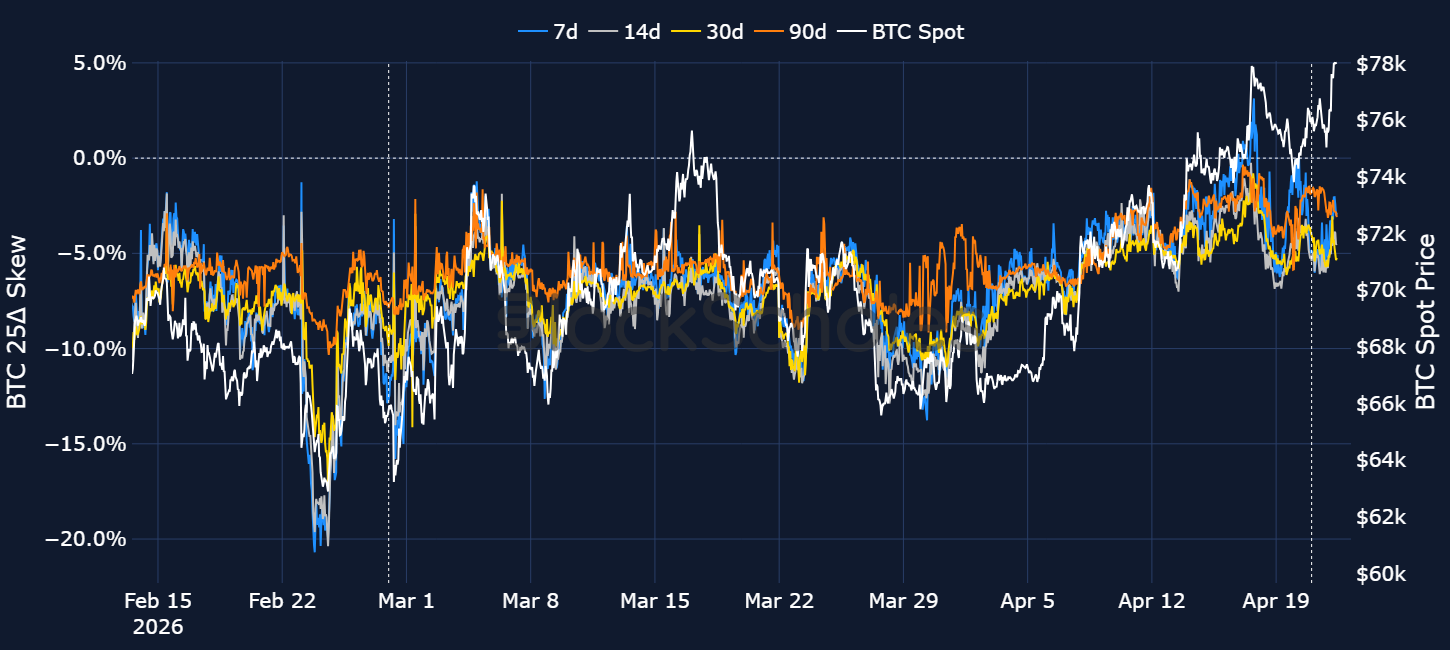
Like in ETH markets, that positive premium towards out-the-money BTC call options did not last long.
Despite spot price once more reaching $78K (the same level it traded at when 7-day skew rose to 3.1% on April 17, 2026) skew has yet to turn bullish again and is currently trading at -2.9%.
For now it appears that options markets are refusing to turn bullish with serious conviction due to the back-and-forth uncertainty in diplomatic efforts between the US and Iran.
However, beneath the surface, a number of bullish catalysts underpinning buy-side demand have emerged:
Strategy purchased $2.54B worth of bitcoins over the past week, marking the digital asset treasury’s largest purchase since November 2024.
Spot Bitcoin ETFs including IBIT have purchased over $1.5B worth of bitcoins since last week, marking a sixth straight day of inflows.
Overall, such flickers of bullish sentiment suggest that major cryptos remain sensitive to developments surrounding the Middle East conflict, even sidestepping the largest DeFi hack so far in 2026.
For a deep dive into the almost-US$ 300 million DeFi hack, download this week's Bybit Learn x Block Scholes report.
Grab Up to 100 USDT in Rewards
Also, enjoy 555% APR on Bybit Earn products!