Bybit Crypto Insights Report: The rise of decentralized perp DEXs: How Aster matches Hyperliquid
AI Summary
Show More
Quickly grasp the article's content and gauge market sentiment in just 30 seconds!
The Rise of Aster
Aster’s rise to fame in the decentralized perpetual DEX space has been swift and strategic, fueled by a perfect blend of timing, innovation and high-profile backing. Emerging from the merger of Astherus and ApolloX, Aster launched with a powerful combination of yield-generating assets and a robust trading engine, offering features such as MEV-free execution, hidden orders and dual-mode interfaces for both retail and pro traders.
Aster’s September 2025 token launch was a spectacle: ASTER surged over 300% within hours, reaching a $1.33 billion market cap in just two days. This explosive debut was amplified by a public endorsement from Binance founder Changpeng Zhao (known as CZ), who praised Aster on social media, sparking speculation that it was being positioned as a direct challenger to Hyperliquid.
The timing couldn’t have been better, as on-chain perpetual trading has been booming (with monthly volumes surpassing $750 billion) and traders are hungry for fresh narratives. Aster’s aggressive leverage options, sleek UI and plans for a ZK-powered chain make it a standout, while its integration with the Binance ecosystem gives it instant credibility. In just weeks, Aster has transformed from an under-the-radar project into a flagship contender in the DeFi perp wars.
Hyperliquid was the trailblazer that defined the blueprint for decentralized perpetual DEXs long before Aster entered the scene. Now that Aster has burst onto the stage with its own bold approach — how does it stack up against the pioneer?
How Aster stacks up against Hyperliquid
Feature | Aster | Hyperliquid |
Launch strategy | Ecosystem-first via BNB Chain and other chains | Infrastructure-first with custom Layer 1 |
Market cap | $2.5B | ~$13.2B, dominant market share |
Trading volume | $20B in September 2025 | ~$200B in September 2025 |
Technology | Modular design, dual-mode UI, planning ZK-powered chain | HyperBFT consensus, HyperEVM, sub-second finality |
User experience | Simple Mode (retail) + Pro Mode (advanced) | CEX-like speed and depth, fully on-chain matching |
Leverage | Up to 1,001x (extremely high-risk) | Standard high leverage, more conservative |
Fees | ~0.01% maker/0.035% taker | ~0.01% maker/0.03–0.05% taker |
Token | ASTER (8B supply, aggressive airdrops) | HYPE (established, steady adoption) |
Backing | Binance ecosystem, CZ endorsement | Independent, community-first ethos |
Source: Compiled by Bybit as of Sep 22, 2025
Based on the above brief comparison, it’s highlighted that there aren’t many differences in terms of technology backup between Aster and Hyperliquid other than the Hyperliquid has built on its own chain and Aster mainly atop BNB Chain.
The key distinction is that Hyperliquid has no clear centralized exchange linkage, while Binance supports Aster.
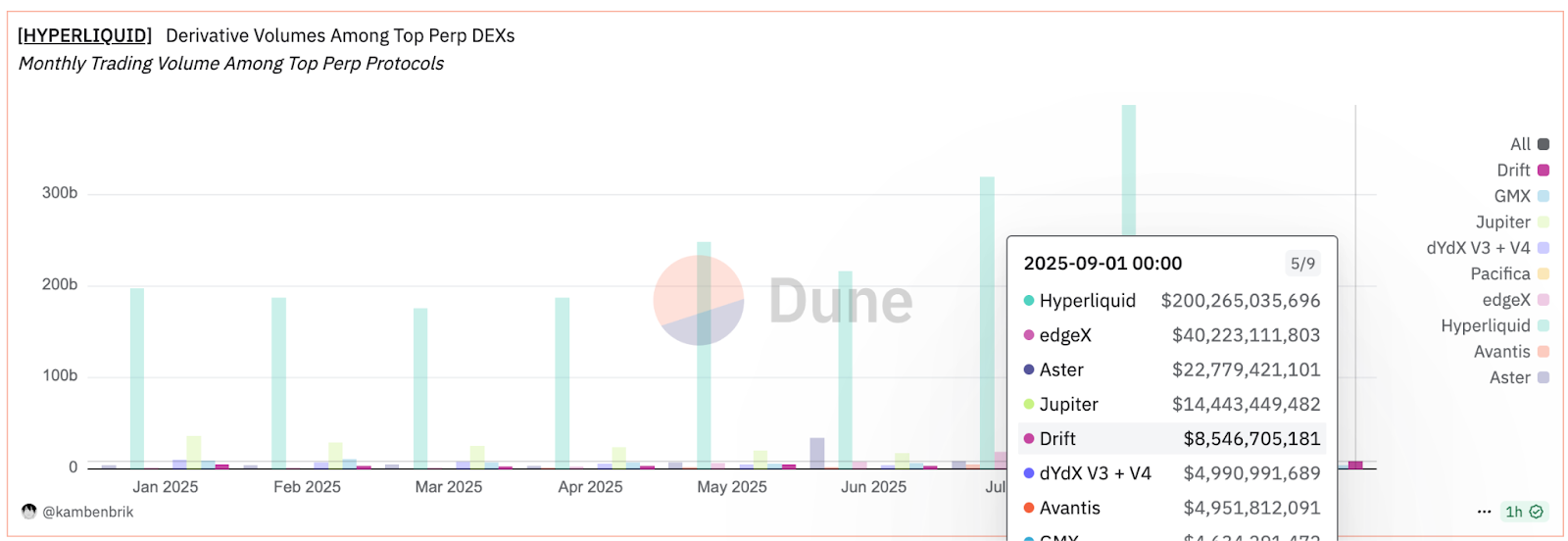
However, in terms of trading volume, Aster’s is around 1/10 of Hyperliquid’s as of this writing (Sep 22, 2025). Aster clearly still has room to grow.
How is Hyperliquid different from dYdX/GMX?
dYdX and GMX are two legacy players of decentralized perpetual trading. You may wonder: If decentralized perp trading isn’t a new thing, why is it becoming all the rage again?
Legacy players among decentralized perp DEXs emphasize decentralization, while newcomers such as Hyperliquid focus on CEX-like liquidity and execution. In sum, Hyperliquid and Aster sacrifice decentralization for execution.
Hyperliquid and beyond
By all appearances, the crypto industry has moved on from decentralization. The ideals that once defined web3 — trustlessness, censorship resistance and community governance — are now taking a backseat to speed, liquidity and user experience. And yet, in this paradoxical moment, decentralized perpetual DEXs are thriving. Why is that?
The primary answer is that they offer the illusion of decentralization wrapped in the performance of centralized exchanges. But illusions are fragile, and Hyperliquid — the undisputed leader in this space — may be facing its most existential threat yet.
Hyperliquid didn’t just build a DEX — It built an entire blockchain optimized for trading, with HyperBFT consensus, sub-second finality and fully on-chain matching. It delivered what others only promised: a CEX-like experience without the custody risk. For a while, it seemed untouchable. But then came Aster.
Aster didn’t innovate on infrastructure; it innovated on narrative. Backed by Binance’s ecosystem and turbocharged by CZ’s endorsement, Aster launched with a modular design, dual-mode UI and a token that exploded 300% in value over two days. It didn’t need to build from scratch — it needed to capture attention, and it did. Now, with centralized players realizing they can spin up their own “decentralized” DEXs overnight, Hyperliquid’s moat looks shallower than ever.
The road ahead
This is the new game: decentralization as a feature, not a foundation. Aster proved that with enough distribution, branding and incentives, you can mimic the benefits of decentralization while retaining centralized control. And if Binance can do it, so can OKX, Bybit or any other CEX with a dev team and a token budget.
Hyperliquid’s challenge isn’t technical. It’s existential. How does a protocol built on purity compete in a market that rewards performance theater? Its infrastructure is superior, but infrastructure doesn’t trend on X. Tokens do. Memes do. CZ tweets do.
To survive, Hyperliquid must evolve — not by abandoning its principles, but by translating them into culture. It needs to build an ecosystem, not just a protocol. It needs community incentives, developer tooling and a narrative that resonates beyond “we’re fast.” Because in this market, speed is table stakes. Story is everything.