CFD vs. TradFi Perpetuals on Bybit: Understanding the key differences
AI Summary
Show More
Quickly grasp the article's content and gauge market sentiment in just 30 seconds!
Disclaimer: Please note that Bybit TradFi has been renamed to Bybit CFD as of July 2026. Bybit CFD is powered by Infra Capital (Mauritius FSC licensed). |
Bybit's TradFi section offers two ways to trade traditional financial assets such as gold, forex, indices, stocks and commodities using USDT-based collateral. The two products are CFD, which supports trading through MetaTrader 5, Bybit App and Bybit Web, and TradFi Perpetuals, which are Bybit-native perpetual contracts. Although both provide exposure to traditional assets, they run on different infrastructure and suit different trading styles.
Although both products sit under the TradFi section, they are separate trading products rather than different account modes or interfaces for the same product. This guide compares their platforms, account requirements, fees, leverage and trading mechanics to help you choose the one that best fits your trading style.
Key Takeaways:
CFD and TradFi Perpetuals both provide exposure to traditional assets using USDT-based collateral, but they run on different trading engines and account structures.
CFD supports MT5 with lot-based execution, daily swap fees and up to 500x leverage. TradFi Perpetuals are Bybit-native perpetuals with funding rates, 24/7 trading and your existing UTA.
Choose CFD if you want MT5 tools and broad instrument coverage. Choose TradFi Perpetuals if you want seamless 24/7 access from your existing Bybit account.
What is CFD on Bybit?
CFD (Contract for difference) is Bybit's trading product for traditional assets within the TradFi section. It uses a dedicated MT5 CFD Account separate from your Unified Trading Account (UTA). USDT or BYUSDT transferred into this account is displayed as USDx at a 1:1 ratio for balance display and accounting purposes. USDx is not a cryptocurrency and cannot be deposited or withdrawn directly.
Orders are placed using standard lot sizes, and the platform offers advanced charting, Expert Advisors for automated strategies and a broad instrument selection across forex, metals, indices, stocks and commodities. CFD provides access to more than 400 instruments across traditional markets.
If you've used a traditional forex or CFD broker before, the interface will feel familiar.
What are TradFi Perpetuals on Bybit?
TradFi Perpetuals are Bybit-native perpetual contracts on traditional assets. They run on the same engine as crypto perpetuals like BTCUSDT and use your existing UTA, so there is no separate account to create or fund. Trading follows the same general interface, margin framework and perpetual-contract mechanics used for Bybit's crypto derivatives.
On the Bybit platform, TradFi Perpetuals are listed under Futures in the navigation. On the trading page, the Futures category includes both perpetual and expiry-dated contracts for crypto. Currently, only perpetual contracts are available under TradFi.
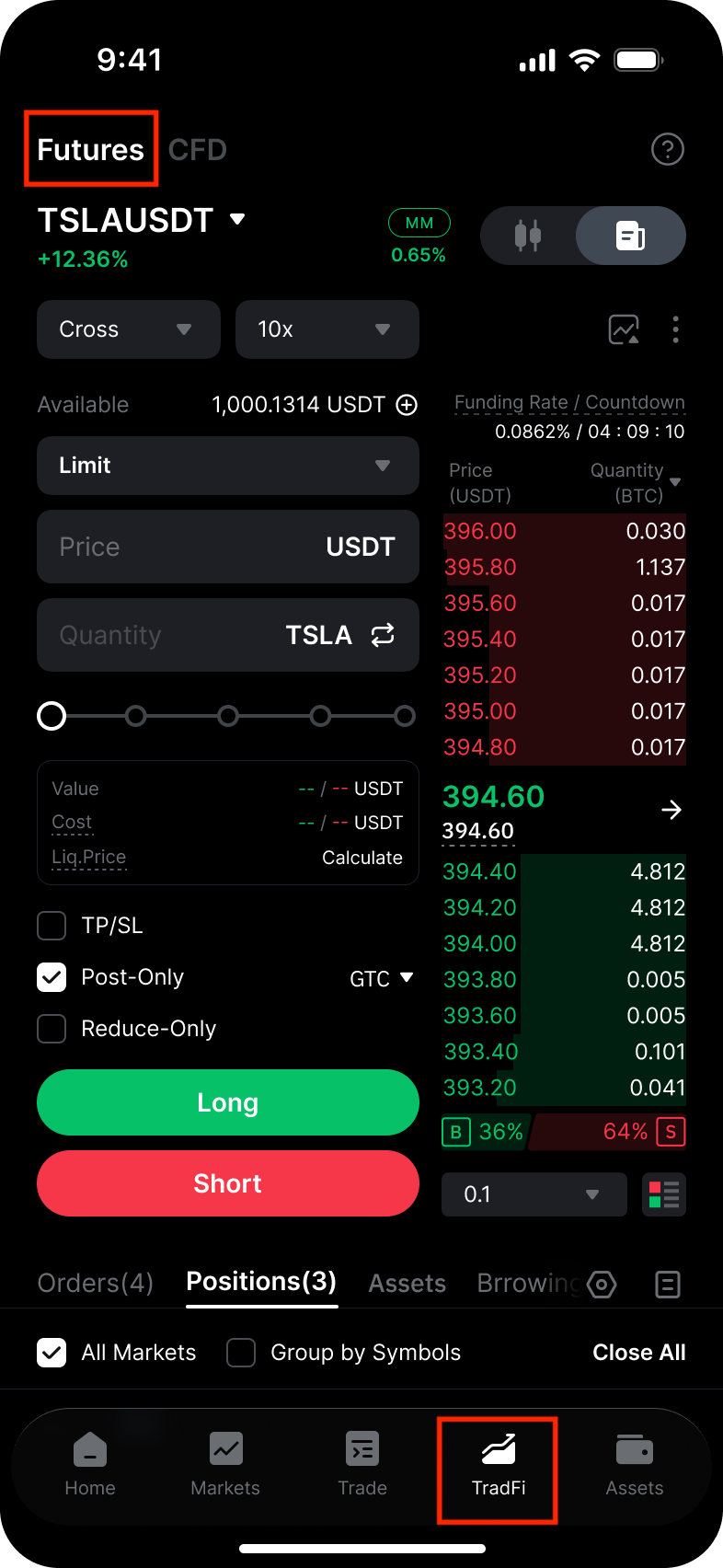
If you can trade crypto perpetuals, you'll feel at home trading TradFi Perpetuals.
Key differences between CFD and TradFi Perpetuals
Platform and account
CFD requires a dedicated trading account. You need to create a separate MT5 CFD Account and fund it with USDT or BYUSDT, which is then represented as USDx at a 1:1 ratio. The interface mirrors a traditional forex or CFD broker, with lot-based orders and MT5's full charting and automation toolkit.
TradFi Perpetuals live inside Bybit's native trading interface. They share the same matching engine, ledger and margin system as all other Bybit derivatives. No extra account is needed. Your UTA balance (USDT) is available immediately.
Trading hours
CFD follows traditional market hours. Instruments follow traditional market hours (Monday to Friday). Only around 20 stock CFDs support 24/5 trading; the rest have shorter sessions depending on the underlying exchange schedule.
TradFi Perps trade 24/7 with no weekend gaps. This can be valuable when news breaks outside standard market hours. You can react to geopolitical events or commodity supply shocks on a Saturday without waiting for markets to reopen Monday morning.
Holding costs: swap fees vs. funding rates
The two products handle position costs differently.
CFD uses daily swap fees. If you hold a position past the broker server time (typically 00:00), you are charged or credited a swap fee. On one weekday, a triple swap applies to cover the weekend closure period.
TradFi Perpetuals use a funding rate mechanism. Long and short holders pay or receive funding fees at scheduled intervals (typically every few hours). This keeps the contract price aligned with the index price and works in the same way as the funding mechanism used for crypto perpetuals.
Fee structures
CFD generally offers lower trading fees than TradFi Perps. It provides two account modes (see TradFi Fees Explained):
Zero-Fee Mode: No separate commission. Trading costs are included in the spread.
Tight-Spread Mode: Narrower spreads, with commissions calculated separately. Designed for active and high-frequency trading.
TradFi Perpetuals use Bybit's standard taker/maker fee model, the same structure applied across all Bybit derivatives. VIP tier discounts from your overall trading activity apply automatically.
Leverage
CFD offers leverage of up to 500x, with the available limit depending on the instrument and asset class.
TradFi Perpetuals use a dynamic risk-limit model. Leverage adjusts based on position size and follows the same structure as Bybit's crypto perps. This generally allows flexible leverage that scales with your tier and position.
Comparison summary
Feature | CFD | TradFi Perpetuals |
|---|---|---|
Engine | Infra Capital (supports MT5, Bybit App, Bybit Web) | Bybit-native |
Account | MT5 CFD Account (separate from UTA) | Unified Trading Account (UTA) |
Collateral/balance | USDT or BYUSDT represented as USDx | USDT through the UTA |
Trading hours | Follows underlying market | 24/7 |
Holding costs | Daily swap fees | Funding rates (every few hours) |
Fee model | Zero-Fee or Tight-Spread pricing | Taker/maker + VIP discounts |
Leverage | Up to 500x, depending on instrument | Dynamic risk-limit model |
Margin system | MT5 CFD Account | UTA cross-margin / portfolio margin |
Order sizing | Standard lots | Contract-based |
Instruments | 400+ across traditional markets | Core pairs across major categories |
Which product should you choose?
Both products provide leveraged exposure to traditional assets. The right choice depends on your trading style, account preference and how you want to manage positions.
Based on your preferences
Choose CFD if:
You're already familiar with MetaTrader 5 or other broker-style platforms
You want advanced charting, Expert Advisors or automated trading strategies
You trade primarily during standard market hours and prefer lot-based execution
You need access to the broadest range of forex, stocks, indices and commodities
You want lower trading fees compared to perpetual contracts
You want high liquidity for gold trading specifically (XAUUSD)
Choose TradFi Perpetuals if:
You already trade crypto perpetuals on Bybit and want a familiar interface
You want to trade traditional markets 24/7 using your existing UTA
You prefer Bybit's native margin system and VIP fee discounts
You want to manage crypto and traditional positions from the same trading environment
Based on your trading style
Swing trading (multi-day holds): CFD applies overnight swap charges, while TradFi Perpetuals use recurring funding rates. Traders holding positions across multiple days should compare the applicable swap and funding costs, as both can vary.
Scalping and day trading: TradFi Perps use Bybit's maker/taker fee model and may incorporate VIP fee benefits. CFD traders can choose Tight-Spread Mode, which offers narrower spreads with separately calculated commissions and is designed for active and high-frequency trading. Compare the total spread, commission and holding costs under each product before choosing.
Algorithmic and automated trading: CFD gives you access to MT5's Expert Advisors, a mature ecosystem of automated strategies and custom indicators. TradFi Perps can be automated through Bybit's API, which you may already use for crypto bots.
Weekend and off-hours trading: Of the two products, only TradFi Perps trade continuously over weekends. CFD follows traditional market hours and pauses over weekends. If you want to react to breaking news on a Saturday, TradFi Perps give you that access.
Existing crypto traders: TradFi Perps require no new account, interface or margin system. CFD requires learning MT5 and funding a separate account, but offers broader market coverage.
The bottom line
CFD brings professional trading tools and 400+ instruments to the Bybit ecosystem through a dedicated account. TradFi Perpetuals extend Bybit's native perpetual infrastructure to traditional markets without requiring a separate trading account.
Neither is inherently better. CFD suits traders who want depth and MT5-specific features. TradFi Perps suit traders who value seamless integration and 24/7 access. Many traders use both products, depending on the asset, market hours and trading strategy. To get started, see the guides for trading on the web or trading on the Bybit App.
#LearnWithBybit