USDJPY+ hits our upside target before Yen's historic intervention!
AI Summary
Show More
Quickly grasp the article's content and gauge market sentiment in just 30 seconds!
ICYMI: USDJPY+ finally hit our upside target set since June 22nd!
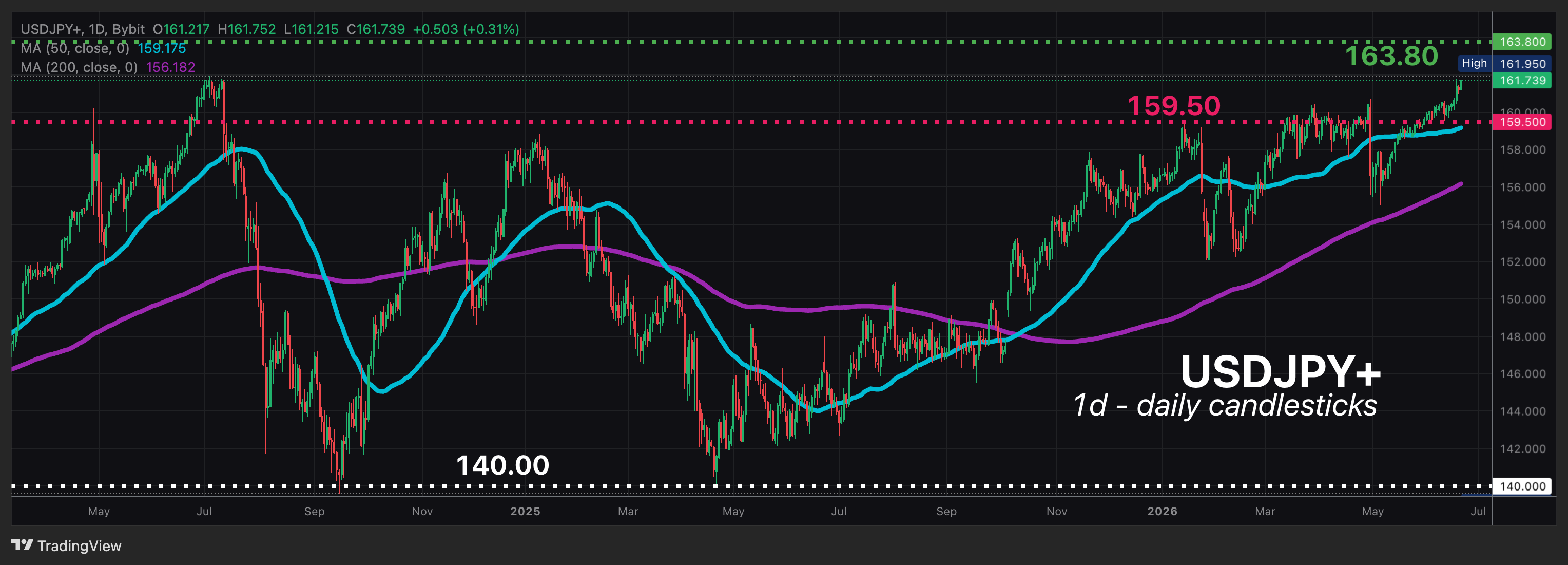
A month later, on July 23rd ...
USDJPY+ soared to a fresh 40-year high (since 1986) as it finally hit that upside target of 163.80!
(also highlighted in our June 24th "Market Pulse" report - scroll to bottom)
July 23rd-29th: Notably, during those 5 trading days ...
Markets respected that upside target!
Traders didn't dare push USDJPY+ much higher past 163.80, only managing to flirt with the psychologically-important 164 line.
In short, around 163.80 was just about as good as it got for USDJPY+ bulls (those hoping prices will go higher).
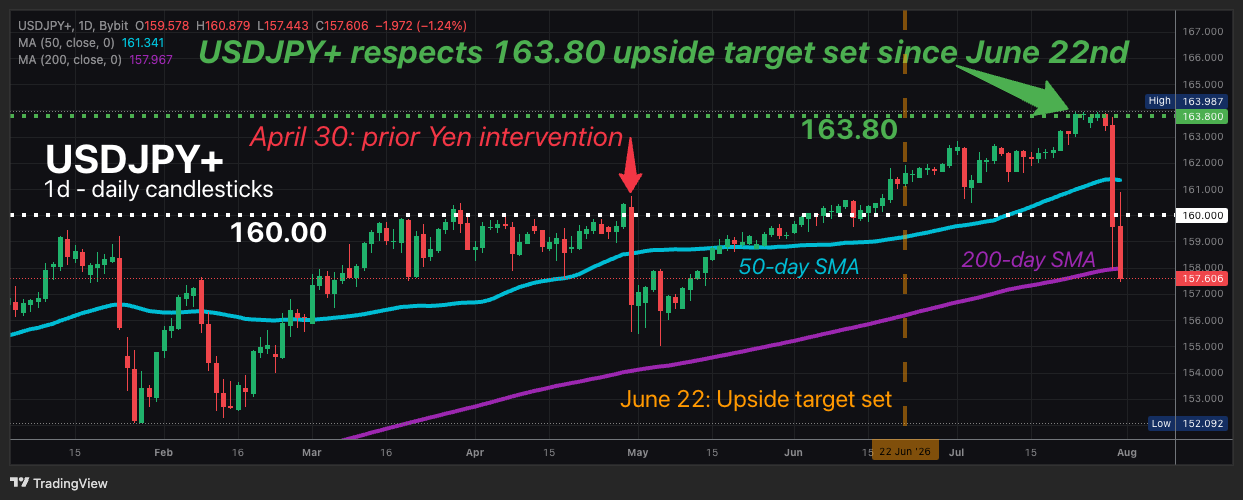
Then, USDJPY+ witnessed history!
July 30th:
Japan stepped in and bought yen / sold dollars, spending a record ~$53 billion (¥8.45 trillion) in a single day.
That's the biggest ever one-day intervention by Tokyo.
The yen surged (USDJPY+ fell) as much as 3.3% in a single day - its biggest intraday gain since December 2024.
July 31st:
The Japanese government and the BoJ (Bank of Japan) intervened in the forex market for a 2nd straight day - this time, with the help of US Treasury Secretary Scott Bessent!
The Federal Reserve Bank of New York reportedly sold euros to buy yen on behalf of the US Treasury.
Both the US and Japan bought the yen together to strengthen the currency.
By Friday's close, USDJPY+ had fallen to 157.606 on Bybit's trading platforms - marking the lowest levels for USDJPY+ (strongest Yen vs. the US Dollar) since mid-May.
NOTE:
USDJPY moves down on a stronger Yen and/or weaker US dollar
USDJPY moves up on a stronger US dollar and/or weaker Yen.
How Currency Intervention Works
Who decides to intervene?
Japan's Ministry of Finance (MoF) gives the order. The Bank of Japan (BoJ) executes the trades.
What makes this latest bout of intervention notable is that Japan didn't do this alone: there was coordination with the US, and possibly even with South Korea (Reuters reported that Seoul also sold US dollars).
How does intervention work?
Japan sells US dollars from its foreign reserves of about US$ 1 trillion, and uses the proceeds to buy yen.
Such yen purchases boost demand for the JPY and push its price up (and USDJPY down).
Why?
A weak yen makes imports (especially energy and food) more expensive, hurting ordinary Japanese people through inflation.
The yen at a 40-year low against the US dollar was a growing problem for policymakers.
Has Japan intervened before?
Yes. There have been multiple interventions in recent years.
Most recently, back in late-April 2026, with the Yen weakening to its lowest level (USDJPY+ reached its highest level) since July 2024 ...
Japan spent a record amount of nearly US$ 74 billion for that month (April 2026) to prop up the yen.
Fast forward to the July 30-31 episode, that ~US$ 53 billion amount cited earlier in this report appears to be the record amount spent intervening in the Yen for just one day.
What does this mean for USDJPY moving forward?
This was a historic, coordinated move between the US and Japan to stop the yen's slide.
Hence, traders may now think twice before "shorting" the Yen (speculating that the Yen will weaken further), at least for the short term.
Still, markets are aware that the effects of currency interventions can prove short-lived.
After Japan's previous intervention in late-April, USDJPY+ had erased all of those declines by early-June.
In order for JPY to rebound sustainably against the US dollar, markets need to see the following fundamental changes:
Japan rate hikes that closes the gap between interest rates in Japan vs. The US
(Note: a currency tends to strengthen at the thought of its country's interest rates moving higher)
Managable budget deficit in Japan: investors often buy a currency, to invest in that country, when its government spending plans (fiscal policies) appear sustainable and responsible.
Lower oil prices: Japan is a net importer of energy. If the government has to spend more to buy oil, then it has less money to grow its economy, giving rise to concerns surrounding its fiscal standing (see point above).
The Bloomberg FX Forecast model predicts a 76.7% chance that USDJPY may only revisit the 164.00 psychological level by year-end, or fall to as low as 147.00 over the next 5 months.
Of course, much of where USDJPY is headed to for the rest of this year should greatly depend on the fundamental outlook, as influenced by, among other things:
Middle East conflict's impact on oil prices
Fed vs. BoJ rate hikes
US/Japan fiscal spending policies (noting that the US has the crucial midterm elections in November)
GBPUSD+ and EURUSD+ also respect upside targets!
Also among G10 FX pairs ...
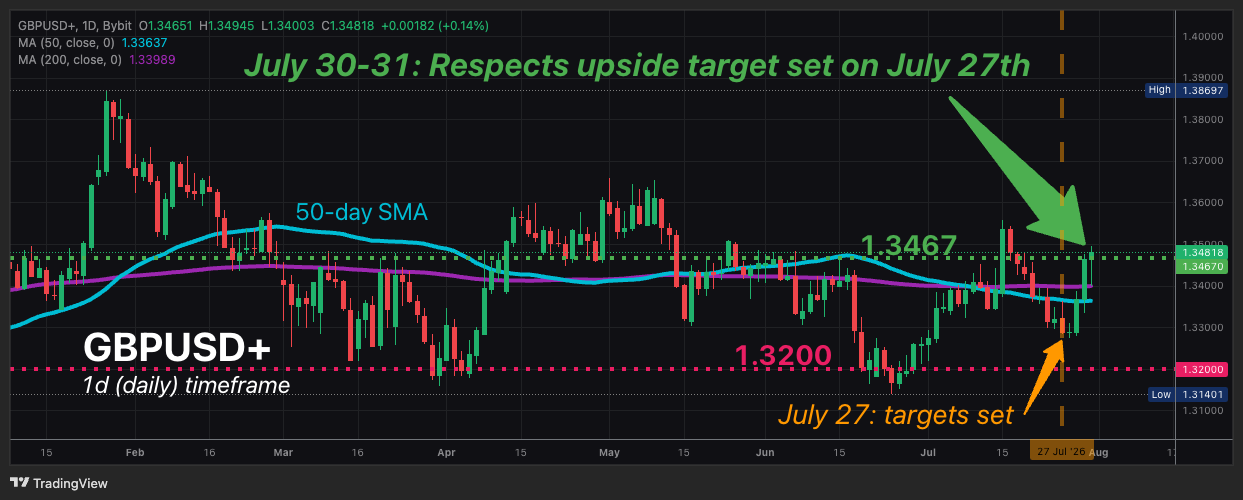
July 30-31: GBPUSD+ respects 1.3467 upside target set since Monday, July 27th ("3 Assets to Watch").
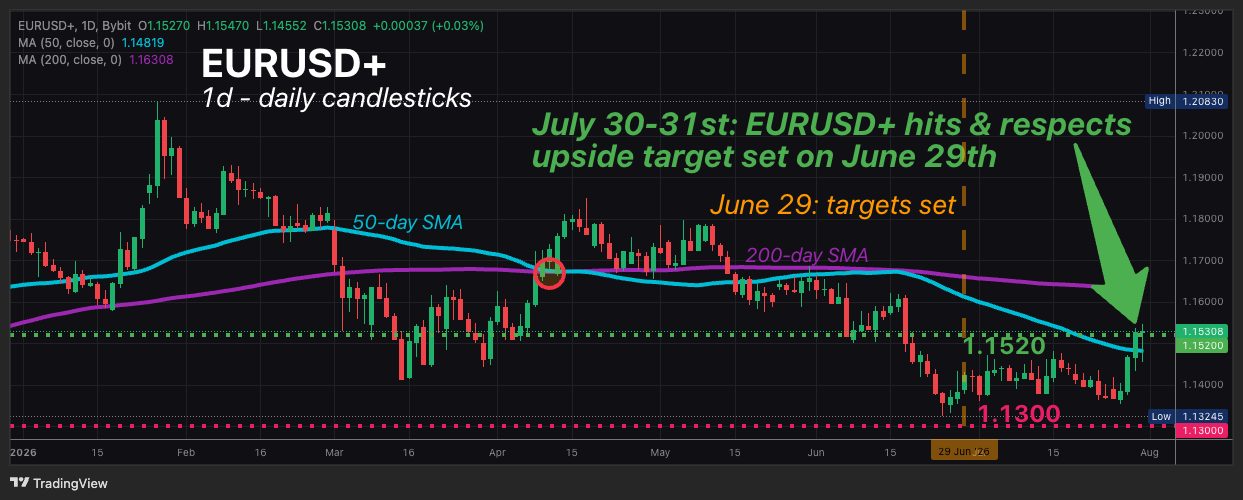
July 30-31: EURUSD+ respects 1.1520 upside target set since June 29th.
For fresh trading ideas and insights you can act upon, follow Bybit Learn's "Market Pulse".
DISCLAIMER:
This article is provided for general information and reflects the author’s views only. It does not constitute investment advice, nor an offer or solicitation to buy or sell any financial instruments or digital assets. Your ability to access or use any products or services mentioned may be subject to the laws and regulatory requirements of your jurisdiction.
Grab Up to 100 USDT in Rewards
Also, enjoy 555% APR on Bybit Earn products!