AI Stocks Alert: Will DeepSeek's new flagship models crash US tech stocks again?
AI Summary
Show More
Quickly grasp the article's content and gauge market sentiment in just 30 seconds!
Today, Chinese AI startup DeepSeek launched preview versions of its highly anticipated V4 Flash and V4 Pro models.
DeepSeek positions V4 as the most powerful open-source platform, directly challenging OpenAI and Anthropic, while touting its cost efficiencies.
Throwback: DeepSeek's breakthrough 15 months ago sparked US$1 trillion selloff in US tech stocks
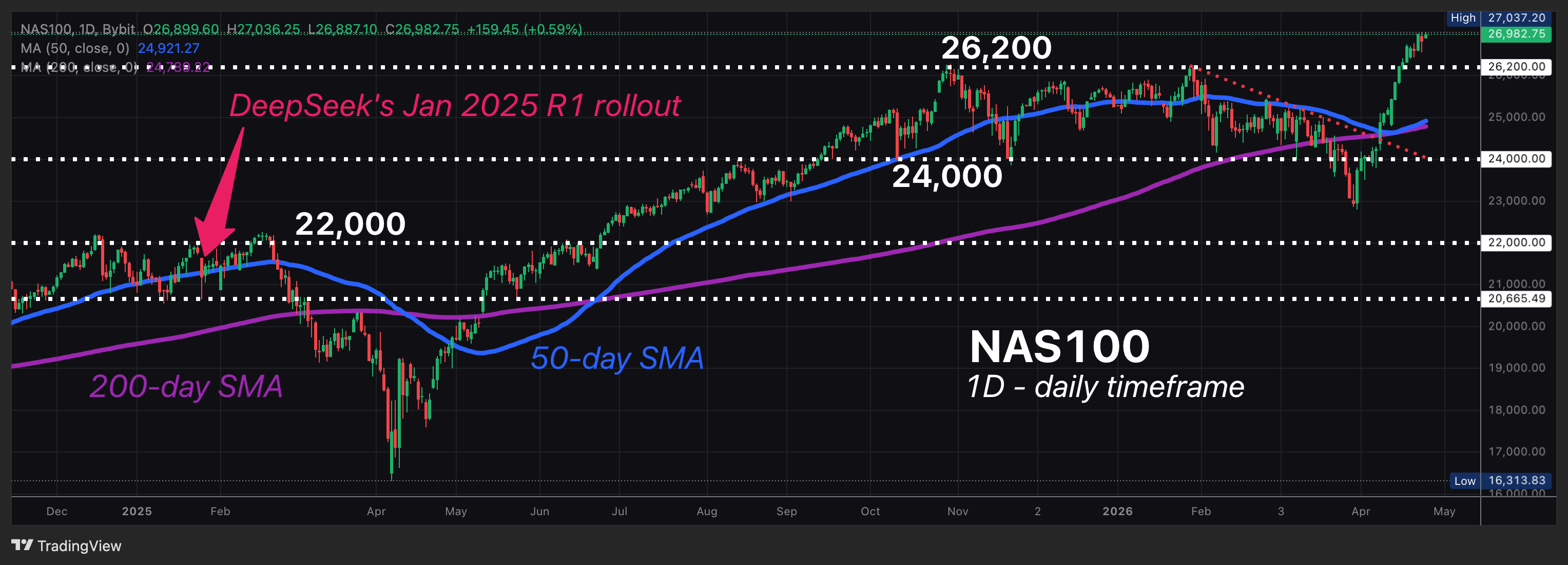
Recall back in late January 2025, DeepSeek released its R1 model.
That made investors seriously question whether the hundreds of billions spent on AI by its US peers were justified.
DeepSeek's rollout back then triggered a selloff in US equities on January 27th, 2025
Nasdaq 100 wiped out about US$ 1 trillion in market cap, falling 3.5%
Nvidia alone lost nearly US$ 600 billion in market value as it plummeted 17%!
Will January 2025 selloff be repeated?
It's unlikely.
Here are 3 reasons why (key differences between DeepSeek's announcements in January 2025 vs. April 2026):
1) Market already recalibrated: The January 2025 selloff was seen as a "measured recalibration" of where AI profits will flow, not a bubble burst. Since then, US tech stocks have gone on to post fresh record highs.
2) Positive interpretation emerging: JPMorgan views cheaper AI models as a "net positive" for global equities, driving incremental growth and efficiency gains.
3) Resilient AI-demand: Recent earnings announcements by major AI players still point to robust earnings growth ahead, which suggests that AI infrastructure spending still has momentum.
April 23: Intel reported stellar Q1 earnings just yesterday, expects "double-digit growth" moving forward.
April 16: TSM (Taiwan Semiconductor Manufacturing Co.) expects revenue to grow over 30% this year, after reporting a near-60% increase in profits.
The upcoming week will also see the latest earnings reports out of Alphabet, Apple, Microsoft, Amazon, and Meta, with all of them combined (excuding Apple) having pledged to invest US$ 650 billion into AI in 2026.
If these US hyperscalers (huge spenders on AI infrastructure) continue to signal resilient AI demand, that should help negate concerns surrounding DeepSeek's latest rollout.
How are markets reacting now? What about the next 12 months?
The tech-heavy Nasdaq 100 index is actually rising 0.6% at the time of writing, pushing back towards its all-time high above the 27,000 mark!
Ask TradeGPT: How can I trade an asset that's already hit a record high?
Here's how AI-linked stocks within the Bybit universe are reacting now (as of 8:45 AM UTC during US pre-market on Friday, April 24), along with their respective 12-month potential upside according to Bloomberg's surveyed analysts:
Intel +22.8% (12-month potential upside: 3%)
TSM +3.4% (12-month potential upside: 16%)
Sandisk +1.8% (12-month potential upside: -0.6%; stock appears to have already run ahead of current analysts' projections)
Western Digital +1.7% (12-month potential upside: -10%; stock appears to have already run ahead of current analysts' projections)
Vertiv +1.5% (12-month potential upside: 5%)
Microsoft +1% (12-month potential upside: 39%)
Tesla +0.8% (12-month potential upside: 11%)
Nvidia +0.2% (12-month potential upside: 35.5%)
Alphabet +0.2% (12-month potential upside: 14%)
Meta +0.1% (12-month potential upside: 29%)
Amazon flat (12-month potential upside: 12%)
Apple -0.5% (12-month potential upside: 10%)
Today's pre-market price reaction suggests that the concerns surrounding DeepSeek's threat have likely been fully digested, with more upside still expected for AI stocks over the longer-term.
FUN FACT: The Philadelphia Stock Exchange Semiconductor Index has climbed every single session since March 30th - that's 17 straight days of gains - a record run!
Bottom line
DeepSeek's innovation validates AI's trajectory while AI stocks' resurgence for much of April 2026 shows infrastructure demand remains strong.
Rather than triggering panic, today's developments suggest a maturing, more diversified AI investment landscape with opportunities beyond pure-play chip stocks.
Grab Up to 100 USDT in Rewards
Also, enjoy 555% APR on Bybit Earn products!