How to combine trading strategies across market conditions
AI Summary
Show More
Quickly grasp the article's content and gauge market sentiment in just 30 seconds!
Most traders learn one strategy, ride it through the phase that rewarded it, then watch it stop working once conditions shift. A trend follower who thrived through a strong rally often gives back gains once the price starts chopping sideways. A range trader who profits from predictable support and resistance gets stopped out repeatedly the moment a genuine breakout arrives.
These examples are common cases caused by a mismatch between the strategy and the current market regime. Combining your approaches — rather than committing everything to just one — lets you stay positioned for whichever conditions occur in the market. When one approach stalls, another part of your strategy portfolio can still be working.
In this guide, we detail how to identify the regime you're trading in, which strategies suit each one and how to run several strategies at once on Bybit using Futures, Grid Bots and Bybit Earn.
Key Takeaways:
No single strategy performs well across every market condition. Combining your approaches helps you smooth out returns.
Markets cycle through three core regimes — trending, ranging and volatile markets — and each one favors a different strategy.
A practical multi-strategy portfolio can run trend trades, Grid Bots and Earn allocations simultaneously.
Why one strategy isn't enough
Every trading strategy has a market regime it's built for and a regime that quietly erodes it. A moving-average crossover system, for instance, can post strong results through a trending quarter, catching the bulk of a directional move with minimal whipsaw along the way. Put that same system into a choppy, range-bound quarter and the signals flip back and forth, bleeding out a good portion of the earlier gains through repeated false entries.
This dynamic, known as regime dependency, applies to nearly every strategy type you'll come across. For example, a trend-following approach degrades in sideways markets because it keeps entering positions that reverse before they develop into anything. Conversely, a range strategy gets stopped out repeatedly once the price breaks out of its channel and starts trending in one direction.
Of course, neither of these strategies is flawed on its own. The problem is in relying on one strategy across conditions it was never designed for.
Combining strategies with different sweet spots — rather than rotating in and out of a single strategy — produces more consistent results across a full cycle. No matter which market regime happens to be active, part of a well-designed portfolio is already positioned for it.
How to identify the current market regime
Before choosing a strategy, you need a reliable read on which regime is currently active, since applying the wrong tool to the wrong condition is where most of the damage occurs. Three core regimes cover most of what markets do. Each one leaves signals that are straightforward to spot once you know where to look. These core market regimes are as follows:
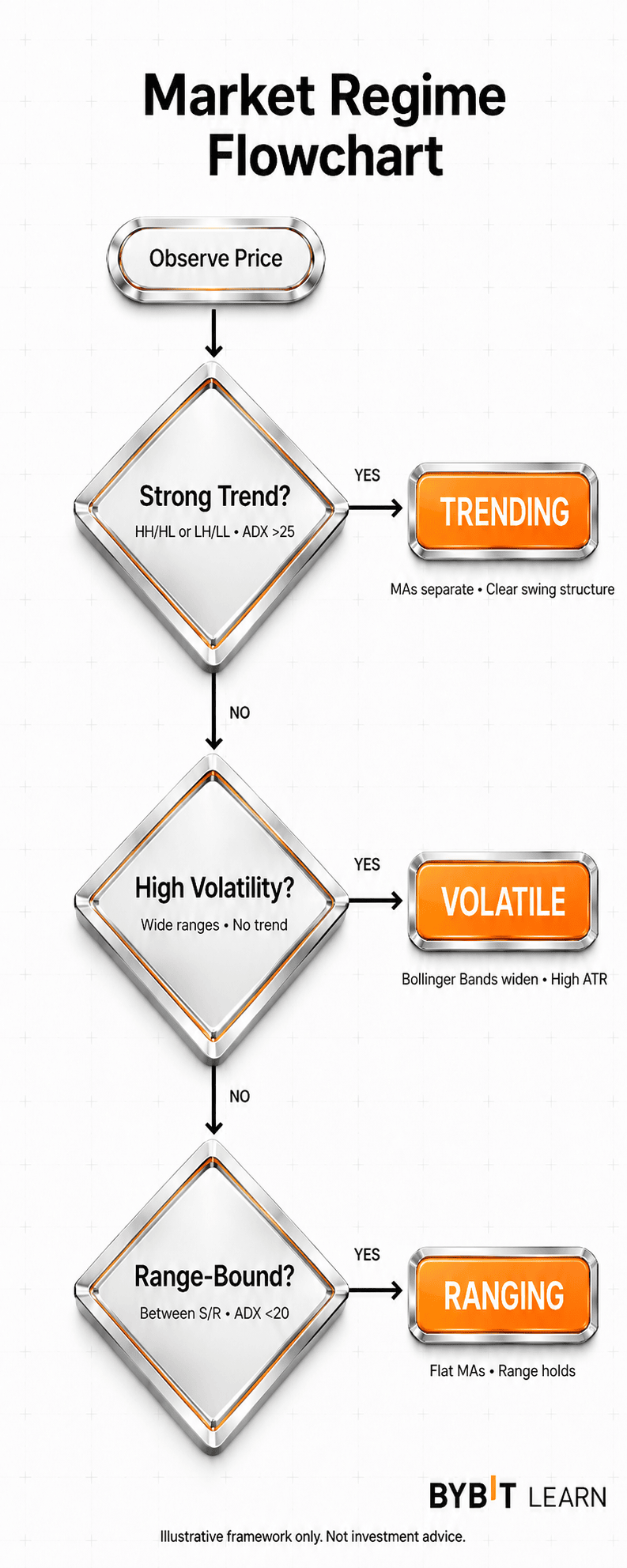
1. Trending (up or down). Price prints a sequence of higher highs and higher lows in an uptrend, or lower highs and lower lows in a downtrend, without much overlap between swings. Average directional index (ADX) readings above 25 confirm genuine directional strength, rather than short-lived noise. Moving averages separate from each other and slope consistently in the trend's direction, rather than sitting flat and tangled together the way they do in a stagnant market.
2. Ranging. Price oscillates between a defined support level and a defined resistance level without decisively breaking either, repeatedly testing the same zones. ADX drops below 20, reflecting the absence of directional strength on either side. Moving averages flatten out and start crossing back and forth frequently, since price isn't establishing a consistent enough direction for them to track over time.
3. Volatile or uncertain. Daily ranges widen well beyond their recent averages. Bollinger Bands® expand outward noticeably as price swings widen on both sides. There's no clear directional bias in either case; the price can break either way once a major catalyst resolves, which separates this regime from a genuine trend.
These signals are by no means exhaustive. Each indicator mentioned here has more depth than is covered in this overview. For more detailed information on technical indicators, consult Bybit’s articles on leading and lagging indicators, MACD, RSI and DMI, or visit the Indicators section on Bybit Learn.
Failing to identify the prevalent regime puts an unsuitable strategy in front of the wrong conditions for as long as the trader keeps misreading the regime. Before you commit to any strategy at all, your first job as a trader is to correctly spot the current market regime.
The flowchart below details the signals you can use to identify the prevalent market regime.
Matching strategies to market conditions
Once you’ve identified the current market regime, find which strategy fits it and which Bybit tools support that strategy in practice. The table below breaks down each of the three core regimes into common scenarios you're likely to encounter — since "trending" or "volatile" rarely shows up in exactly the same way twice across different scenarios.
Market condition | Strategy | Relevant Bybit tools |
Strong uptrend | Trend-following | Spot, Perpetual Futures, trailing stop, TP/SL |
Strong downtrend | Short selling | USDT Perpetuals, Inverse contracts, TP/SL |
High volatility | Breakout trading | Advanced orders (stop orders), TP/SL |
Event-driven | Volatility trading | Options, conditional orders |
Uncertain direction | Hedging | Options, Futures |
Sideways/range | Buy support, sell resistance | Spot Grid Bot, Futures Grid Bot |
Low volatility | Mean reversion, carry | Grid Bot, Easy Earn (idle capital) |
Trending conditions (rows 1 and 2 in the table above). In a strong uptrend, trend-following works because price is doing the heavy lifting. Your job is largely to stay in the position, and to let a trailing stop protect gains as the move extends further than expected. A strong downtrend flips the same logic into short selling: inverse contracts or USDT Perpetuals let you position against the direction, with TP/SL orders defining the exit before you ever enter the trade.
It’s important to note that any form of Futures trading involves leverage. For this reason, position sizing and stop placement carry more weight than they do in spot-only strategies, as losses can wipe out your margin if a position isn't managed properly.
Volatile or uncertain conditions (rows 3, 4 and 5 in the table above). Wide swings ahead of a scheduled catalyst suit breakout trading: stop orders trigger entries once price clears a defined level in either direction, letting you capture the move without needing to predict which way it breaks in advance. When direction is uncertain, you'd rather hedge exposure than guess at an outcome. This is where options contracts come into play, though the mechanics of structuring an Options position — such as strike selection and expiration — is a separate topic that’s covered in Bybit's introduction to Options. Event-driven volatility trading works similarly, positioning ahead of a known catalyst with conditional orders that trigger only when specific price or time conditions are met, rather than sitting in the market unconditionally through the event itself.
Ranging/low-volatility conditions (rows 6 and 7 in the table above). When price is stuck between two defined levels, directional strategies tend to underperform. However, Grid Bots don't need a direction in order to work. A Spot or Futures Grid Bot places a ladder of orders across a price range and profits from the oscillation itself, buying dips and selling rallies automatically without requiring you to time each swing manually. In low-volatility stretches, when even ranging feels sluggish and thin, idle capital can earn a return through Bybit Easy Earn. This keeps your funds productive — as opposed to letting them sit unallocated in your account balance.
Building a multi-strategy portfolio
Matching one strategy to one market regime is relatively straightforward once you know how to read the signals. Running several strategies at once — because different assets are often sitting in different regimes simultaneously — is where a multi-strategy portfolio actually starts paying off. For instance, Bitcoin (BTC) might be in a sustained uptrend while a mid-cap altcoin is trading sideways in a tight range at the exact same time. There's no reason a single account can't hold positions suited to both conditions at once, instead of forcing one strategy across everything you hold.
A practical structure uses three components working in parallel, each one with a distinct role within your portfolio:
Futures (trend trade). This is the core directional position, following whichever asset is showing a clear trend at the time. A long BTC Perpetual position with a trailing stop attached during a confirmed uptrend is a straightforward example of this. The trailing stop locks in gains as price extends, without requiring you to manually adjust the exit level every time the price moves. This component does the heavy lifting when a genuine trend is underway.
Grid Bot (range capture). When BTC is trending, an altcoin that’s trading within a defined range isn't going anywhere directionally. However, it’s still oscillating — and a Grid Bot captures that chop automatically, without needing a directional view at all. It buys near the range low and sells near the range high on a repeating basis, without requiring you to time each individual swing yourself. This component earns from conditions in which funds would otherwise sit idle, or get chopped up by a directional strategy applied where it doesn't belong.
Easy Earn (idle capital). Not all capital should be deployed into active positions at every point in time. Your USDT that isn't currently allocated to a trend trade or a grid strategy can instead sit in flexible savings, earning a return, rather than sitting completely idle in your balance until the next setup appears.
As you can see, each of these three components serves a different function within your account:
The Futures position captures direction
The Grid Bot captures range
The Earn allocation keeps unused capital productive
Your portfolio stays active across whatever mix of conditions actually shows up, rather than only working when one specific regime is present.
A sample allocation might look like this:
Component | Sample allocation | Role |
Futures (trend trade) | 50% | Directional exposure |
Grid Bot (range capture) | 30% | Range/chop capture |
Easy Earn (idle capital) | 20% | Capital preservation and yield |
Note: This split is illustrative only, not a recommendation. It should not be read as an optimal or guaranteed-return allocation for every account. Your actual weighting depends upon your risk tolerance, capital size and number of assets you're actively tracking across regimes at once. As noted earlier, Futures positions carry leverage risk that should be sized carefully regardless of how conservatively the rest of the portfolio is structured.
There's no fixed ratio that works for every trader or every market cycle. The split above exists to illustrate how the three components interact, and is not intended to prescribe a specific number for you to copy directly into your own account.
Managing risk when conditions change
Regimes don't announce their ends clearly. They may fade gradually or break suddenly, and a portfolio built for the old regime needs to be adjusted before the new one fully takes hold and does damage.
Watch for signals that a regime is ending, such as a trend that loses momentum if ADX declines from above 25 or a range breaking decisively through support or resistance.
Scale positions gradually, since conditions shift, instead of closing everything and reentering all at once. A false breakout can reverse before a genuine regime change actually confirms itself.
Let TP/SL orders and trailing stops manage exits automatically so that a delayed manual reaction doesn't turn an ordinary regime shift into a larger loss.
Keep your total portfolio risk in mind across all active strategies at once, not each one in isolation. A Futures position and a Grid Bot can both draw down together if correlated assets move against you simultaneously.
Common mistakes
Below are some of the most common mistakes traders make while managing a multi-strategy portfolio:
Switching too frequently. Reacting to every noisy candle, rather than a confirmed regime shift, leads to constant strategy-hopping. This can quietly erode returns through fees, slippage and mistimed entries taken too early.
Abandoning a strategy during normal drawdown. Every strategy has losing streaks within its own regime. Exiting at the first sign of drawdown often means missing the recovery that follows shortly after.
Running too many strategies without clear rules. Adding more strategies isn't automatically better if you can't clearly define when each one should be active and when it should be paused.
Ignoring correlation between strategies. Two positions that appear diversified on paper can move together if the underlying assets are correlated — thereby concentrating risk, rather than spreading it as intended.
Switching on gut feeling rather than defined triggers. Market regime changes should be confirmed by objective signals, such as ADX or a broken range — not by a hunch that a particular strategy has run out of its applicability.
The bottom line
Markets move through cycles, and no single strategy dominates all conditions. A trend follower gets rewarded in trending conditions and punished in ranging ones, and the reverse holds true for range-based approaches. Combining strategies, rather than committing to just one, keeps you positioned across whichever market regime happens to be active at any given time.
Bybit supports running multiple strategies from a single account, and combining Futures positions, Grid Bots and Earn products so your capital stays active, regardless of which market regime shows up next. Explore these tools directly on the Bybit trading page.
#LearnWithBybit
Grab Up to 100 USDT in Rewards
Also, enjoy 555% APR on Bybit Earn products!