AMD stock outlook in 2026: How to trade AMD on Bybit
AI Summary
Show More
Quickly grasp the article's content and gauge market sentiment in just 30 seconds!
As of mid-2026, NVIDIA still owns the AI accelerator headlines, but its key competitor, AMD, has spent the past year quietly transforming into a business with solid revenue growth behind it. Instinct MI300 and MI400 GPUs compete directly against NVIDIA's data center lineup, while EPYC processors keep eating into Intel's server CPU base. What separates AMD from a pure AI story is its diversified focus: data center, gaming, embedded and client segments all contribute solidly, so weakness in one niche doesn’t sink the stock.
This article looks at AMD's 2026 performance (as of early July 2026), the bullish and bearish forces shaping its outlook and how to trade AMD on Bybit.
Key Takeaways:
As of mid-2026, AMD stock is posting strong growth rates, with the company’s data center segment acting as the primary driver.
The stock is trading at a steep premium to historical rates, leaving little room for execution missteps.
You can trade AMD on Bybit through a TradFi stock CFD or the AMDSTOCKUSDT TradFi Perpetual contract.
AMD market performance in 2026
As of Jul 22, 2026, AMD’s market capitalization is around $887 billion, a figure that reflects how far sentiment has shifted since the AI trade broadened beyond NVIDIA.
Market cap: $887.75 billion
YTD return: 149%
1-year return: 245%
52-week range: $149.22–$584.73
Analyst median 12-month price target: $520 (roughly 4.5% below the current $544.43 share price)
Wall Street consensus: 38 buy, 10 overweight, 10 hold, 0 underweight, 0 sell
Zero “sell” ratings on a stock up 245% in a year point to a telling consensus: the disagreement among analysts right now is mostly about the degree of growth, not direction.
AMD stock outlook in 2026
Bullish factors
AMD’s data center revenue hit almost $5.8 billion in Q1 2026 (up 57% year-over-year) on EPYC demand and Instinct GPU shipment growth.
EPYC server CPUs captured 46.2% of server CPU spending in Q1 2026 (per data from Mercury Research), an all-time high that points toward eroding Intel dominance.
The MI400 series, confirmed for second-half 2026 shipment, targets NVIDIA’s Blackwell and Rubin computational architectures, boasting 432GB of HBM4 memory — about 1.5x the comparable NVIDIA capacity.
Ryzen™ AI laptop design is helping to secure major supplier contracts as OEMs refresh lineups through 2026.
Following the Xilinx acquisition, AMD's Adaptive and Embedded Computing Group (AECG) strengthened its embedded and edge AI business beyond GPUs.
A near-zero debt-to-equity ratio gives AMD real buyback capacity.
Gross margin expanded to 55% in Q1 2026 while data center revenue grew as a share of mix.
Bearish factors
AMD's data center business is still a fraction of NVIDIA's. Estimates put AMD's data center share in the mid-single digits versus NVIDIA's 80%-plus.
NVIDIA's CUDA software computing platform has a two-decade head start that still defines enterprise AI development. AMD's competing ROCm open-source software has matured, but production-grade adoption lags behind.
AMD Management has predicted gaming revenue to decline over 20% in the second half of 2026 versus the first half, reflecting a maturing console cycle.
China export restrictions remain a live issue for the company. Management has acknowledged revenue headwinds tied to MI308 licensing.
Execution risk on the MI400 timeline also exists, with analysts questioning whether the mass-production ramp will slip into 2027, a claim AMD disputes.
Valuation is stretched: AMD's forward P/E sits near 60x, above NVIDIA's ~22x and Qualcomm's ~21x, leaving little cushion if growth decelerates.
What AMD traders should watch for in 2026
AMD is one of the most closely watched NVIDIA challengers in AI accelerators — but "closely watched" isn’t the same as "competitive." The bull case rests on a simple premise: hyperscalers want a credible second supplier so they aren’t fully dependent upon one vendor's pricing and allocation decisions.
A handful of catalysts will decide how this plays out through the rest of 2026. MI400 shipment timing sits at the top of the list, as AMD has confirmed a second-half launch. However, the gap between engineering samples and mass-production volume is where past road maps have slipped before. Quarter-over-quarter data center revenue growth, EPYC server share trends and any new ROCm enterprise adoption milestones are the numbers worth tracking each earnings cycle, alongside fresh hyperscaler design wins.
The bear case is less about AMD's hardware and more about switching costs: CUDA lock-in means enterprises often stick with NVIDIA, even when AMD's specs compete on paper. Compounding this issue is the company's premium valuation, which leaves little room for a disappointing quarter.
How to trade AMD on Bybit
You can trade AMD on Bybit either as a TradFi stock CFD or as a TradFi Perpetual contract.
TradFi stock CFD
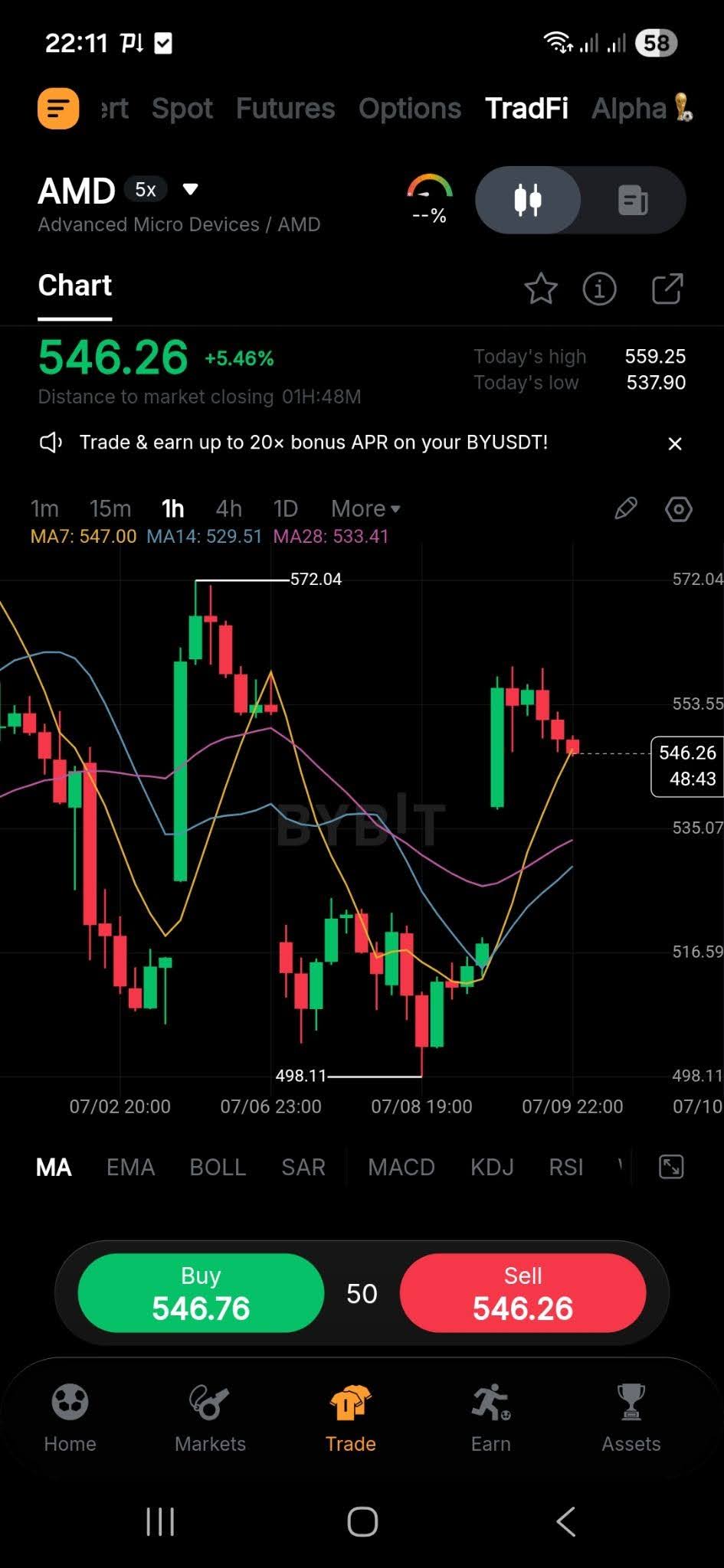
To trade AMD as a stock CFD on Bybit TradFi, which offers leverage of up to 5x, follow these simple steps:
After transferring USDT to your TradFi Account, choose AMD from the available Stocks under the Trade → TradFi menu.
Set the direction of the trade (Buy or Sell), the order quantity and all other order parameters.
Initiate the trade by clicking on Buy or Sell.
TradFi Perpetual Contract
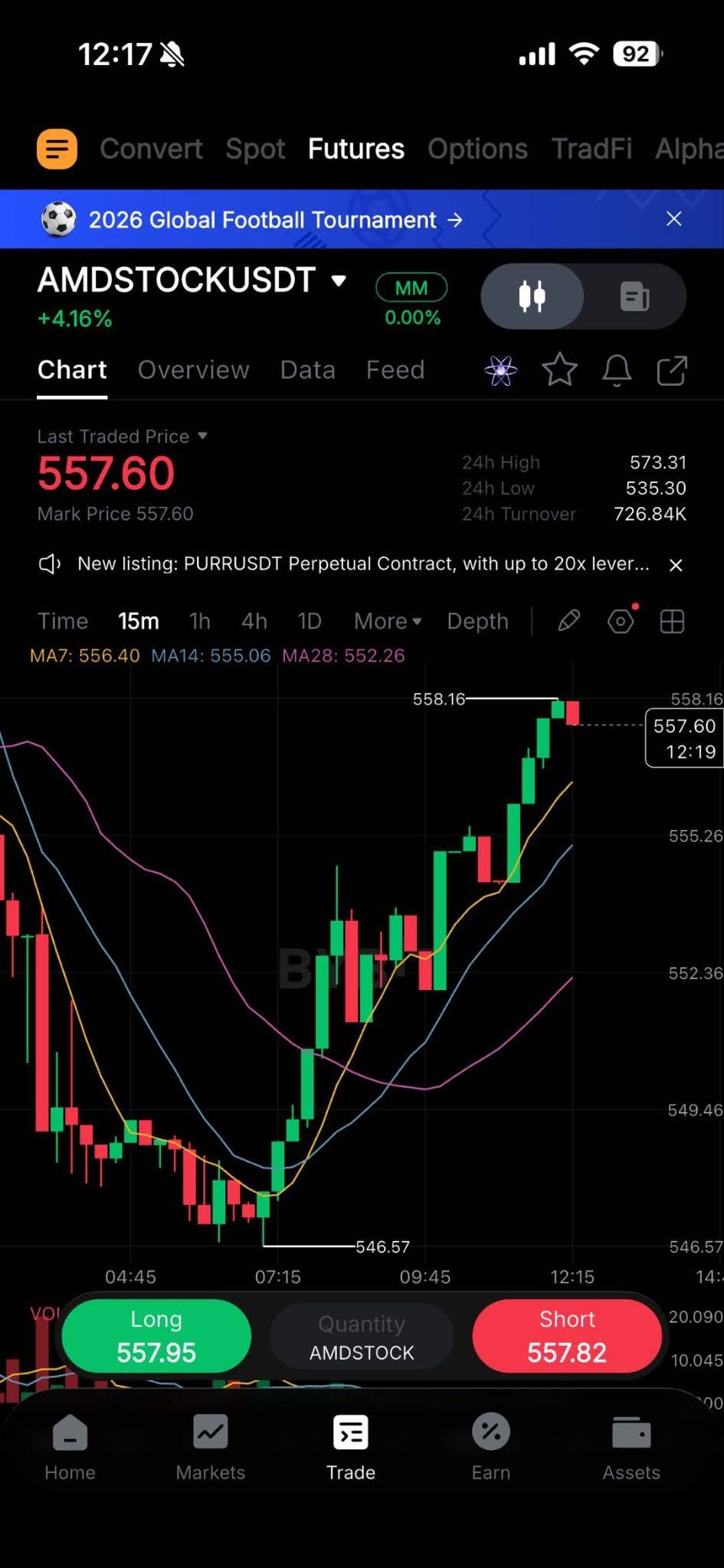
You can also trade AMD as a USDT-settled TradFi Perpetual contract with leverage and 24/7 availability. As a perpetual contract , positions have no expiry date and remain open until you close them.
Fund your Unified Trading Account (UTA) with USDT.
Search for the AMDSTOCKUSDT ticker in the Trade → Futures tab.
Adjust your leverage settings according to your personal risk management strategy.
Input your order details, then click on Long or Short to execute your trade.
Closing thoughts
AMD's position as the clearest alternative to NVIDIA in the area of AI compute gives it a growth story few chipmakers can match. The stock's valuation already prices in a lot of that story playing out cleanly. Watch quarterly data center revenue growth and MI400 delivery timelines closely, since a disappointment on either front could reduce investor confidence and put pressure on AMD's valuation.
To trade AMD and other AI semiconductor stocks, explore Bybit TradFi now.
Disclaimer: This article is for informational purposes only and does not constitute financial advice. Trading stock CFDs and perpetual contracts involve leverage and carry a high risk of loss; you should assess your own risk tolerance and consider independent financial advice before you trade. |
#LearnWithBybit